
Ushio in Life
Ushio’s Light-Based Technology: Supporting the AI-Driven Transformation of Social Infrastructure
- Comfort / Convenience
- Optical Equipment

The Supporting Role of Semiconductors in the Emergence of the AI Era and the Development of a Digital Society
Today, AI has grown beyond mere convenience; it now performs intellectual tasks that were once exclusive to humans and is a crucial tool for alleviating severe labor shortages. Semiconductors are essential for everyday devices like smartphones and PCs, as well as next-generation elements of social infrastructure, such as the IoT, 5G, and autonomous driving. Tens of millions of chips will be required to build an AI infrastructure, and demand for semiconductors is expected to continue to grow with the digitalization of society.
Shift in Focus from Front-End to Back-End Processes: Innovative Semiconductor Technologies Supporting a Next-Generation AI-Driven Society
The realization of an AI-driven society requires semiconductors that offer greater performance than ever before, including higher-speed, larger-volume data processing, extreme miniaturization, and multi-functional integration combined with lower power consumption.
To date, semiconductor evolution has been driven by miniaturization technology in the front-end manufacturing process to create increasingly smaller and finer circuits on chips. While this technology has achieved exponential growth, doubling the number of transistors that can be mounted onto a chip around every two years, it is approaching the limit of what is physically and economically possible. Therefore, the focus of technological innovation is shifting to advanced packaging (ADP) technologies for back-end processing, which involve stacking and densely arranging multiple chips. In particular, chiplet technology, which interconnects multiple small chips by densely arranging them on a substrate, and high-density patterning on substrates are showing great promise as keys to achieving both higher device speeds and lower power consumption.
below for details on
front-end processes.


Evolution of Substrates Supporting Advanced Packaging Technologies: The Importance of Interposers
The evolution of substrates onto which chips are mounted is essential to achieving high-performance packaging.
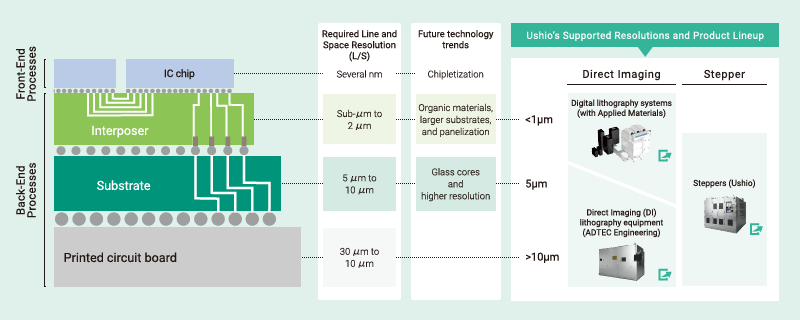
Interposer (intermediate) substrates, in particular, are growing in importance, as they play a central role in connecting multiple chips at high speed and with high reliability. To connect chips at higher density, we are entering a phase in which finer, higher-precision wiring patterns are now required on substrates, with resolutions of sub-μm to 2 μm. Furthermore, as substrates become larger in order to integrate more chips, we are seeing a rapid shift from conventional silicon materials to more efficient organic materials.

Achieving Finer, Higher-Density Patterning, Enhancing Productivity, and Accommodating Larger Substrates
Ushio’s Full-Lineup Strategy: Developing Products That Contribute to the Technological Advancement of AI Semiconductors
Ushio is introducing a strategy to develop a full lineup of lithography equipment to address rapidly changing market needs. In addition to meeting the resolution requirements for each patterning specification, we offer both projection lithography equipment (see “Stepper” in diagram below), which transfers patterns from a photomask, and direct imaging lithography equipment (see “Direct Imaging” in diagram below), which directly draws patterns without a photomask, to meet the diverse needs of semiconductor manufacturers and enhance their productivity. Ushio is also participating in the next-generation semiconductor packaging consortium JOINT3 and actively working to accommodate new materials and structures, such as the development of large panel-level organic interposers.
Digital Lithography Systems (DLT Systems)
Direct Imaging (DI) Lithography Equipment
Steppers
Digital Lithography Systems
(DLT Systems)
Digital lithography systems (DLT systems) are used in fine patterning for high-performance chips for smartphones, PCs, and AI applications. DLT systems enable maskless batch scanning. They offer diverse solutions to a wide range of issues in the back-end process through exceptional optical performance and advanced software, contributing greatly to productivity improvements in the manufacturing process as a whole.
Direct Imaging (DI) Lithography Equipment
Direct imaging (DI) lithography equipment is used to create circuit patterns in the manufacturing of semiconductors and printed circuit boards. It uses laser light to directly draw patterns without the need for photomasks. By eliminating the need for masks, it reduces costs while still performing fine, high-precision patterning. In recent years, with the surging demand for AI, we have introduced equipment that is compatible with ultra-multilayer substrates for servers and are proceeding with development to meet the needs of these markets.
Steppers
The UX-5 series of steppers is adopted in the photolithography process in semiconductor manufacturing and is used when creating package substrates that bear the core components of smartphones and computers. A major feature of the series is its ability to efficiently expose large substrates in four shots, achieving high productivity by covering a larger area per shot.
What is the Difference
Between a Stepper and
DI Lithography Equipment?
A stepper is a piece of equipment that uses projection lithography to transfer the circuit pattern drawn on a photomask onto a semiconductor wafer or substrate using a projection lens. The exposure field is divided into several small sections. After one section is exposed, the substrate is then moved to expose the next section. By repeating this process, the pattern is transferred onto the entire substrate.
In contrast, DI lithography equipment uses direct drawing and no photomask, instead using laser light to draw the circuit pattern directly onto the substrate.
Note that digital lithography systems (DLT systems) also use direct imaging.

Ushio’s Growth Strategy: Supporting AI Infrastructure with Light-Based Technologies
Although the semiconductor market is expected to be affected by the sluggish demand for EVs and the downturn in general-purpose servers in fiscal 2025, competition in AI-related development continues to intensify, with customer demand expected to recover in fiscal 2026 and be fully restored from fiscal 2027 onward. The market for lithography equipment used in advanced packaging, one of our areas of focus, is expected to see significant growth toward 2030, with Ushio’s related lithography equipment projected to achieve a high compound annual growth rate (CAGR) of 15%.

In addition to lithography equipment, Ushio boasts a wide range of light-based technologies that are key to various semiconductor manufacturing processes, such as excimer lamps (for cleaning processes) and thermal processing light sources (for heating processes). Under its New Growth Strategy, Revive Vision 2030, Ushio will continue to use the power of light to resolve issues impeding the progress of technological innovation and contribute to the AI-driven transformation of social infrastructure.

